The European electricity system is undergoing a profound transformation driven by the twin imperatives of decarbonisation and energy security. With a strong shift from fossil-based generation to renewable resources, the resulting variability in electricity supply poses significant challenges to real time grid balancing and system reliability. To address these challenges, Europe has launched an ambitious reform of its ancillary services framework, built on a suite of harmonised, cross-border balancing platforms.
At the core of this transformation are five cornerstone projects. The first is the Frequency Containment Reserve (FCR) Cooperation, which serves as the primary response mechanism for maintaining grid stability. The secondary and tertiary responses are provided by the Platform for the International Coordination of Automated Frequency Restoration and Stable System Operation (PICASSO) [an automatic frequency restoration reserves (aFRR) platform], Manually Activated Reserves Initiative (MARI) [a manual frequency restoration reserves (mFRR) platform], and Trans-European Replacement Reserves Exchange (TERRE) [a replacement reserve (RR) platform], each addressing different classes of reserves critical to frequency stability across different timeframes. Further, Imbalance Netting (IN) within the International Grid Control Cooperation (IGCC) is a process in which transmission system operators (TSOs) collaborate to coordinate the use of secondary responses, thereby avoiding the simultaneous activation of afRR in the opposite direction.
Together, these platforms reflect the technical, regulatory and market innovations underpinning Europe’s transition towards a single integrated electricity market under the European Union (EU) Electricity Balancing Guideline (EBGL). The latter relates to creating a market where countries can share the resources used by their TSOs to ensure a balance between generation and demand. It is also about allowing new players, such as demand response and renewable energy, to participate in this market. The European market design has significantly changed the local procurement rules. In 2024, the four key European energy balancing platforms collectively generated an economic surplus of over EUR 1,450 million.
Figure 1: Key highlights of European balancing platforms
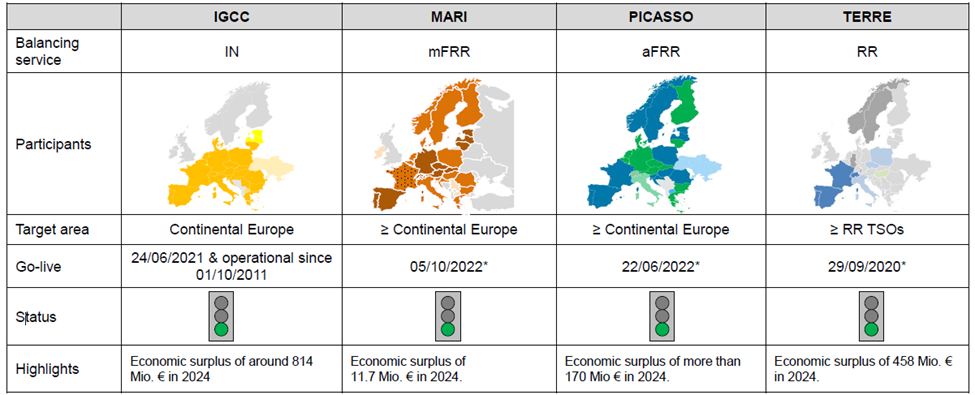
Note: *Date as of when cross-border exchanges were possible due to the neighbouring TSO joining. The technical go-live of the platform was at an earlier date.
Source: ENTSO-E
Pan-European integration
Ancillary services are essential for maintaining system frequency and absorbing shocks from supply-demand imbalances. Historically, ancillary services markets in Europe were designed at the national level, with limited interoperability. However, as cross-border power flows and renewable penetration increased, this fragmented setup became a liability. The EBGL set the foundation stone in 2017 for integrated balancing platforms by mandating some core objectives, including the harmonisation of reserve product definition and activation criteria, enabling real time cross-border procurement, increasing competition and liquidity in the reserve market, and enhancing system flexibility to accommodate renewables.
To implement these goals, Europe’s TSOs, under the umbrella of the European Network of Transmission System Operators for Electricity (ENTSO-E), collaborated to launch the following platforms:
FCR Cooperation
A unified FCR is the first response mechanism, activated within 30 seconds to counteract frequency deviations. The FCR Cooperation platform, launched in 2017, is now the largest shared FCR market in continental Europe. As of 2025, it includes TSOs from nine countries, including Austria (Austrian Power Grid (APG)), Belgium (Elia), Switzerland (Swissgrid), Germany (50Hertz, Amprion, TenneT, TransnetBW), Western Denmark (Energinet), France (French Réseau de Transport d’Électricité [RTE]), the Netherlands (TenneT NL), Slovenia (ELES) and Czech Republic (ČEPS).
The process of market design evolution is based on close cooperation among all the TSOs, national regulatory authorities (NRAs) and stakeholders of the involved countries. The platform operates through daily auctions with four-hour product blocks, where balancing service providers (BSPs) submit offers that are consolidated into a common merit order list. Each day, the BSPs submit bids for next-day delivery. The interaction with BSPs and the contracts between TSOs and BSPs are handled on a national basis, along with the responsibility for delivery. The Gate Opening Time (GOT) is at D-7 11:00 CET, and the Gate Closure Time (GCT) is at D-1 08:00 CET.
The winning bid is determined by the central optimisation algorithm based on certain predefined constraints. These constraints include minimum core share requirements for each load frequency control (LFC) block and maximum export or internal limits between LFC Areas. The primary optimisation objective is to minimise total procurement costs while meeting system needs and respecting these constraints. BSPs can submit divisible or indivisible bids with a minimum bid size of 1 MW. A uniform pay-as-cleared pricing model is mandated, ensuring all accepted providers are paid based on the marginal clearing price.
Despite the market’s high degree of integration, national-level procurement processes remain essential for handling situations of under procurement. If local BSPs in an LFC block cannot fulfil their core share requirement or if total market demand is unmet, local procurement mechanisms are triggered, which fall outside the scope of the regional optimisation.
IN-IGCC
IGCC serves as the official European platform for imbalance netting, designated by ENTSO-E in 2016 under Article 22 of the EBGL. Initially launched in 2010 as a regional project among German TSOs, IGCC has since expanded to include 27 TSOs from 24 countries across continental Europe, forming one of the most extensive real-time balancing cooperations in the world.
As already mentioned, IN helps avoid the simultaneous activation of balancing reserves (aFRR) in opposite directions by TSOs in different areas. Instead of each TSO activating its own reserves, IGCC facilitates the exchange of real time imbalance information and automatically identifies where imbalances can be offset against each other. This results in a single, coordinated correction signal that is sent to each participating TSO’s control system, enabling more efficient balancing actions and reducing the total amount of energy activated.
By optimising the use of aFRR, IGCC improves overall system efficiency, reduces balancing energy costs, and enhances the security of supply. Energy volumes exchanged through the IGCC platform are made public in real time via the ENTSO-E Transparency Platform. These volumes are settled based on agreed opportunity pricing principles, ensuring transparency and fairness in financial settlements between TSOs.
IGCC also includes mechanisms for operational support and flexibility. TSOs facing security issues may temporarily reduce or suspend their participation by notifying others through a standardised process. Such coordination helps maintain system integrity while preserving the benefits of the imbalance netting process.
PICASSO
As Europe’s central mechanism for coordinating aFRR, PICASSO is critical for managing real-time frequency deviations on the power grid, ensuring continuous and reliable system operation. aFRR responds to frequency imbalances by adjusting power output within 5 minutes to 7.5 minutes (full activation time), playing a vital role in balancing demand and supply. Since its inception in 2022, the PICASSO project includes 29 TSOs from 26 countries and 1 observer TSO (Luxembourg’s Creos) besides ENTSO-E.
The core principles of PICASSO are rooted in creating a standardised, integrated European aFRR market. PICASSO uses a standardised 15-minute aFRR product with a unified merit order list and harmonised pricing, ensuring a consistent approach across the European grid. BSPs can submit separate bids for upward and downward regulation, treating each direction as an independent product. Bids are evaluated based on price per MWh (EUR/MWh) under a pay-as-cleared pricing mechanism.
The operational flow is such that ancillary service providers (ASPs) submit tenders to their TSOs for each quarter-hour delivery period. Each TSO, in turn, forwards its aggregated control energy demand, submitted bids, and available cross-border transmission capacity to the central LIBRA optimisation platform. The latter performs a coordinated economic dispatch calculation, identifying the lowest-cost combination of bids that meets the total aFRR requirement of participating TSOs. The resulting activations are communicated back to each TSO, which then triggers delivery from its local BSPs accordingly. This cross-border optimisation is not only the most cost-effective but also technically feasible use of balancing resources on a pan-European scale.
Using a market time unit of 4 seconds, the PICASSO optimiser has performed more than 7.8 million market clearings per month. The PICASSO IT solution is also used for IGCC, which closely interacts with the PICASSO optimisation to maximise the economic surplus while ensuring that the netting potential of all IGCC TSOs is used.
MARI
MARI is Europe’s designated implementation project for establishing and operating a unified platform for exchanging balancing energy from mFRR, and plays a critical role in maintaining power system balance when automatic reserves are insufficient. MARI enables cross-border cooperation to secure manual balancing actions within a 12.5-minute activation timeframe, ensuring grid reliability in a highly interconnected European electricity market.
Recognising the need for early coordination, 19 TSOs formed MARI in 2017 to address technical and regulatory requirements in line with the EBGL. In 2018, this number expanded to 29 TSOs from 26 countries. Their collaborative work resulted in a flexible technical design that accommodates both founding and future participating TSOs. After further regulatory development, the EU Agency for Cooperation of European Regulators (ACER) approved the implementation framework for the mFRR platform in January 2020, triggering a 30-month deadline for full operational readiness, finally launching the platform in 2022 with the participation of the four German TSOs and Czech Republic’s TSO CEPS.
Over time, additional TSOs have joined – with Austria’s APG joining in in June 2023 followed by the Baltic TSOs (Litgrid, Augstsprieguma Tīkls AS and Elering), Portugal’s Redes Energeticas Nacionais (REN), Slovakia’s Slovenská elektrizačná prenosová sústava, a.s. (SEPS) and Spanish Red Eléctrica joining in 2024, and most recently, Belgium’s Elia in May 2025. Further accessions are anticipated throughout 2025. As of May 2025, the platform includes 29 TSOs [13 operational TSOs and 16 non-operational members working toward integration] and four observer members [Serbia (EMS), Ireland (EirGrid), Northern Ireland (SONI) and North Macedonia (MEPSO AD)] besides ENTSO-E.
MARI standardises key aspects of the mFRR product, including a 15-minute resolution, harmonised gate closure times, and a pay-as-cleared pricing mechanism expressed in EUR per MWh. As with PICASSO, bids for upward and downward regulation are treated as distinct products, creating a unified merit order list and promoting efficient cross-border balancing. These features facilitate integration with the broader European balancing framework and ensure a level playing field for all participating BSPs.
For each quarter-hour, BSPs submit their tenders for mFRR energy to their respective TSOs, which then forward the aggregated offers and demand data to the central optimisation system. This system determines the most cost-effective way to meet system-wide demand and dispatches results back to TSOs, who then activate the selected offers within their control areas.
MARI’s phased rollout system with regulatory compliance and focus on interoperability acts as a major step forward in harmonising Europe’s balancing energy markets.
TERRE
The first European platform established for the cross-border RR exchange, TERRE targets the resolution of longer-term system imbalances with an activation time of up to 30 minutes. The platform provides the legal framework for balancing energy procurement, transmission capacity allocation, and settlement across the EU’s internal electricity market. Launched in January 2020, TERRE currently comprises four operational members (REN, Red Eléctrica, RTE and Swissgrid), three former members CEPS, Polish Polskie Sieci Elektroenergetyczne SA (PSE) and Italy’s Terna – which are still involved in the project but not connected to the platform; and two observers Hungary’s MAVIR Zrt and ENTSO-E.
The LIBRA platform forms the technical backbone of TERRE, enabling the pooling of RR bids and the centralised optimisation of energy activation to meet the participating TSOs’ balancing needs. The platform operates with a 15-minute resolution, and energy pricing follows a pay-as-cleared mechanism, mirroring the approaches adopted in later platforms like PICASSO and MARI. This setup supports market harmonisation across the different balancing layers. TERRE has also collaborated with the MARI and Nordic LIBRA projects to share best practices and improve algorithmic efficiency, ensure interoperability and learning between platforms, improving long-term resilience and operational design.
TERRE platform provided critical financial benefits for all countries involved in the project during 2023 and 2024. The monthly average in 2023 was around EUR23 million, and around EUR38 million in 2024. In 2024, the activation volume (187 GWh) was higher than in 2023 (118 GWh).
Despite its significant role, TERRE is now approaching the end of its operational lifecycle. In December 2024, the TERRE member TSOs announced that operations on the LIBRA platform would cease by December 31, 2025, due to unresolved legal constraints. The four TSOs can disconnect from the platform in cooperation with other TSOs until then. After this deadline, operations will cease, and the project will enter its closure phase, involving final settlements, completion of reports, storage of all information and data, disconnection of TSOs, and decommissioning of the platform. The legal impact and consequences related to the end of the TERRE project are tackled by each NRA at the national level.
Conclusion
The evolution of Europe’s ancillary services reflects a landmark shift from national silos to a unified, cross-border balancing system. These platforms collectively reflect the EU’s strategy to deliver frequency stability, market efficiency, and operational resilience in an electricity system increasingly shaped by the variability of renewable energy sources. While TERRE is being phased out due to legal constraints, its pioneering role laid the groundwork for later platforms like MARI and PICASSO. Together, these initiatives operationalise the EBGL’s vision by standardising reserve products, enabling cross-zonal optimisation, and fostering competition across borders.