The operational environment of the European grid is undergoing rapid transformation. Increasing electrification, integration of renewable energy sources, decentralisation of generation, and cross-border interconnections have significantly increased system complexity. At the same time, the grid is exposed to a growing range of risks, including extreme weather events, cyber threats, geopolitical uncertainties, and interdependencies with other infrastructures such as telecommunications and digital systems. Hence, traditional terrestrial infrastructures alone may not be sufficient to address these emerging challenges. As a result, there is a growing need to incorporate an additional space dimension into grid resilience strategies.
In this context, the European Network of Transmission System Operators for Electricity (ENTSO-E) released an executive overview in March 2026 on “Integrating EU Space Programme capabilities (EUSPC) into Europe’s power grid to enhance its resilience”. ENTSO-E has developed a structured reference for assessing how the capabilities of the EU Space Programme (EUSP) can complement existing terrestrial infrastructures used in electricity transmission system operations.
The EUSP provides operational, EU-owned capabilities specifically designed to support public authorities and critical infrastructures. Regulation (EU) 2021/696 establishing the Union Space Programme explicitly provides that the programme shall support security-related needs, including the resilience of critical infrastructures (Article 3(2)(c)). These services are characterised by continuity, security governance and long-term availability, making them particularly relevant for electricity TSOs where failure tolerance is low, and recovery timelines are critical. It provides a common, operationally grounded basis for engagement between TSOs, European institutions and space programme authorities. However, this approach is not prescriptive and does not advocate replacing established operational systems. Instead, it outlines how space-based services can be integrated as complementary layers within hybrid architectures, reinforcing resilience while preserving operational autonomy and national responsibilities. By introducing satellite-based capabilities, the approach enhances situational awareness, secure communications, and trusted timing without replacing existing systems.
Guiding principles
ENTSO-E’s high-level overview is based on a set of guiding principles designed to ensure operational relevance, proportionality and regulatory coherence. These principles are as follows:
- Technology neutrality: The framework does not prioritise space-based solutions over terrestrial ones. Satellite services are evaluated alongside existing tools based solely on their demonstrated operational value and risk-mitigation effectiveness. This ensures compliance is achieved through outcomes rather than prescribed technologies, aligning with EU energy and cybersecurity principles.
- Complementarity and hybrid architectures: Space-based capabilities serve as additional layers within hybrid systems to reinforce—rather than replace—existing monitoring, timing, and communication tools. This reduces systemic vulnerability without creating new dependencies, meeting the Critical Entities Resilience (CER) Directive [EU 2022/2557] requirement for proportionate resilience measures.
- Use-case-driven and proportional deployment: Adoption is voluntary, targeted, and linked to specific operational use cases. This approach respects the diverse configurations and threat environments of individual TSOs. It ensures clear traceability between implementation and the mandatory risk assessments required under the CER Directive.
- Regulatory and security alignment: All integration must comply with EU and national legal frameworks, including network codes on System Operation (Regulation (EU) 2017/1485), Electricity Emergency and Restoration (Regulation (EU) 2017/2196) and Cybersecurity (Regulation (EU) 2024/1366). Security, accreditation, and assurance are treated as intrinsic design constraints, aligned with the Network and Information Systems 2 (NIS2) (Directive (EU) 2022/2555) obligations requiring essential entities to implement risk analysis and information security policies.
- Operational autonomy and subsidiarity: Decision-making authority remains with individual TSOs. ENTSO-E facilitates coordination, interoperability, and knowledge sharing without imposing centralised operational control or new obligations, preserving national responsibilities while enabling efficiency gains and coherence at the European level.
EUSP and its practical uses in the transmission grid
The EUSP offers EU-owned space assets across Earth observation, satellite navigation, secure connectivity, and space situational awareness, enabling the structured integration of satellite-based services to complement terrestrial infrastructure, enhance resilience and support innovation with the broader “New Space” ecosystem.
Earth Observation – for operational intelligence
Earth Observation (EO) services under the EU’s Copernicus programme provide wide-area, systematic and repeatable monitoring of environmental and infrastructure-related conditions, enhancing situational awareness for TSOs, particularly where ground-based monitoring is limited or disrupted. These services support key operational use cases, including vegetation management, flood and soil risk assessment, snow and hydrological monitoring, and post-event damage evaluation. Capabilities such as synthetic aperture radar (SAR) and optical imaging enable all-weather, high-resolution analysis, which, when combined with meteorological and grid data, strengthens both preventive planning and real-time decision-making.
Copernicus data are delivered under a standardised EU framework with assured quality and free, open access, facilitating consistent cross-border use, interoperability between TSOs, and coordinated responses to regional events. From a regulatory perspective, EO services contribute to compliance with the CER Directive by supporting risk prevention, mitigation, and recovery measures. Overall, EO capabilities represent a mature, accessible and non-intrusive layer that can be integrated into existing TSO operations to enhance resilience without altering governance structures.
GNSS – for precision and resilience
Precise and reliable time synchronisation is essential for transmission system operations, supporting monitoring, protection, and control across interconnected grids. Increasing digitalisation, such as synchro phasor measurements and real-time data exchange, has led to growing reliance on Global Navigation Satellite Systems (GNSS), which are satellite-based systems (like Galileo) providing autonomous geospatial positioning, navigation, and timing (PNT). This dependence introduces vulnerabilities, including jamming, spoofing, and meaconing of open signals.
In this context, the Galileo Public Regulated Service (PRS) offers an encrypted, interference-resistant timing capability under governmental control. It is specifically designed for use in degraded or hostile signal environments and provides high-precision timing to substations, control centres and wide-area monitoring systems (WAMS), thereby reinforcing grid synchronisation, improving event correlation and disturbance analysis, and sustaining operational confidence during stressed system conditions.
Regulatory frameworks such as the System Operation Guideline (Regulation (EU) 2017/1485) and the NIS2 Directive require accurate time synchronisation and robust cybersecurity measures for critical infrastructure. In this context, PRS-enabled GNSS timing represents a complementary resilience solution within hybrid timing architectures that enhances protection against advanced interference such as meaconing without replacing terrestrial systems or altering TSO responsibilities, while remaining aligned with technology neutrality, subsidiarity, and existing regulatory frameworks.
GOVSATCOM – for data exchange and communications
Secure and continuous communications are essential for system operations under both normal and emergency conditions. While terrestrial networks remain the primary means for data exchange and control, they are vulnerable to physical damage, cyber incidents, and large-scale disruptions. In this context, satellite-based communications provide an independent and resilient alternative to ensure continuity of operations.
EU-level capabilities such as Governmental Satellite Communications (GOVSATCOM) and the future Infrastructure for Resilience, Interconnectivity and Security by Satellite (IRIS²) infrastructure offer secure, sovereign communication services for authorised users, including TSOs. For the latter, these systems can act as fallback capability, ensuring the availability of command-and-control communications, coordination channels, and situational awareness when terrestrial networks are unavailable or degraded.
SSA – for environmental risk
Certain environmental risks affecting transmission systems originate beyond the Earth’s atmosphere and cannot be effectively detected through terrestrial monitoring alone. Space weather events, such as solar flares and coronal mass ejections, can induce geomagnetically induced currents (GICs) in high voltage networks, potentially causing transformer saturation, protection malfunctions, and, in extreme cases, equipment damage. Although low in probability, these events can have high-impact, system-wide consequences.
Space situational awareness (SSA), particularly space weather services, provides early warning and forecasting capabilities that enable TSOs to anticipate and mitigate such risks. Timely alerts support preventive measures, including network reconfiguration, operational adjustments, and enhanced asset monitoring, facilitating a shift from reactive to anticipatory risk management. SSA enhances situational awareness and strengthens system resilience without introducing new dependencies or altering TSO governance structures.
Financing and implementation model
The implementation of space-based services in transmission system operations is based on coordinated, non-prescriptive approaches that prioritise interoperability, efficiency, and respect for national responsibilities. Given the strategic importance of electricity transmission and the cross-border nature of power systems, a coordinated European approach is more effective than fragmented national initiatives, which may lead to duplication and inconsistent technical standards.
Here, ENTSO-E plays a central facilitative role by aggregating TSO requirements, promoting harmonised architectures, and enabling structured engagement with European institutions and space stakeholders. This coordination supports economies of scale, shared frameworks, and aligned technical interfaces while allowing individual TSOs to retain full control over their operational decisions.
Figure 1: Implementation process for space-based services in the transmission grid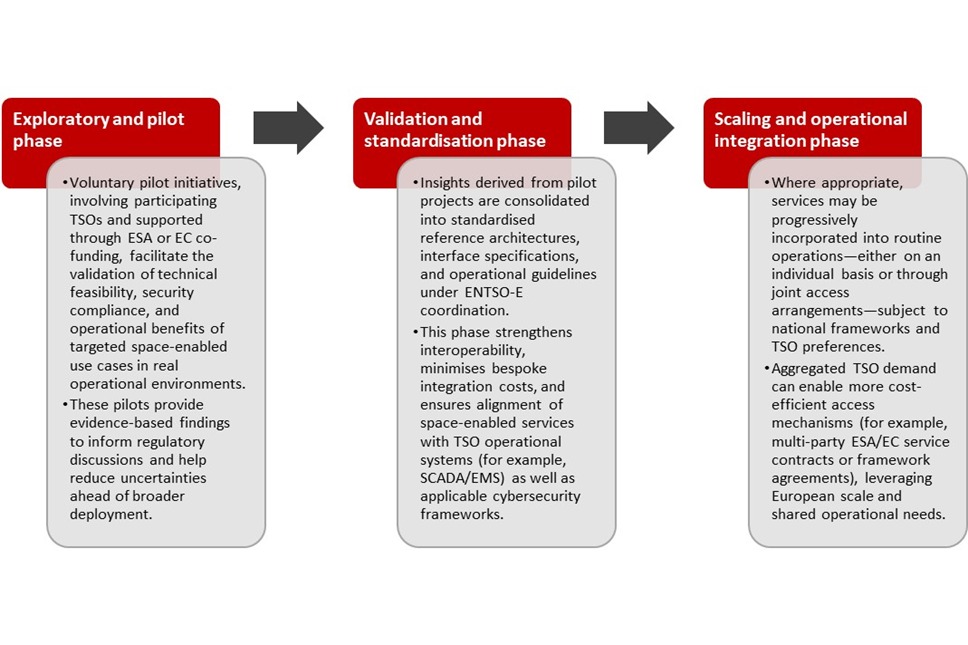
Note: EC – The European Commission; EMS – Energy management system; ESA – The European Space Agency; SCADA – Supervisory control and data acquisition
Source: ENTSO-E; Global Transmission Report
Implementation governance remains lightweight and facilitative. TSOs decide independently on participation, investment, and operational use, in line with national regulations and security constraints. The overall approach emphasises gradual integration—through pilots, testing, and phased deployment—ensuring that space-enabled services complement existing systems and enhance resilience without introducing new dependencies.
The financing of space-enabled services has evolved toward service-based models that minimise upfront capital investment and enable predictable operational expenditure. For TSOs, this allows access to advanced capabilities, such as satellite data, positioning, and communications, without owning or maintaining the underlying infrastructure. A combination of EU funding instruments supports this transition by de-risking early adoption and accelerating deployment. The upcoming EU Multiannual Financial Framework 2028–2034 is expected to strengthen strategic autonomy and resilience investments, with space-enabled solutions for critical infrastructure closely aligned with these priorities.
The European Space Agency (ESA) serves as the primary technical vehicle for developing and validating space capabilities for critical infrastructure, enabling TSOs to engage in co-funded pilots, interoperability testing, and convergence activities through programmes [such as the Advanced Research in Telecommunications Systems (ARTES)], while bridging the gap between capability maturity and operational needs. The European Commission (EC) complements this through instruments such as the Connecting Europe Facility (CEF), which supports cross-border energy and resilience projects, and Horizon Europe, which funds innovation and demonstration activities. Additional support is available via the Digital Europe Programme and future EU space-related funding streams.
These mechanisms are not intended to replace TSO investments but to lower entry barriers, support early-stage deployment, and ensure that solutions are interoperable, scalable, and aligned with EU policy priorities such as resilience and cybersecurity. Over time, the costs of space-enabled services are expected to be integrated into standard operational expenditure as they become embedded within core system operations.
ENTSO-E’s recommendations
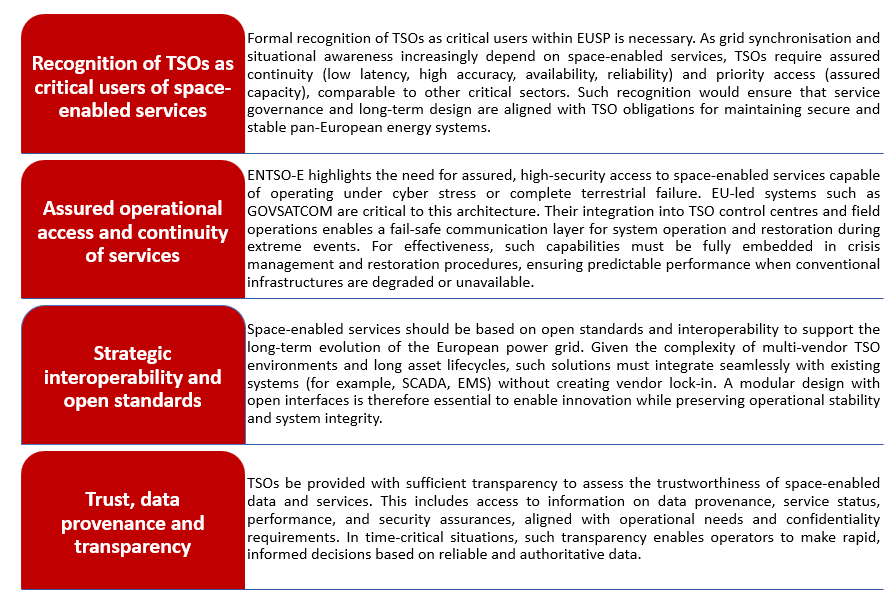
ENTSO-E has developed a set of consolidated, cross-cutting recommendations for stakeholders, institutions, and service providers. These recommendations outline the conditions under which space-enabled capabilities can effectively enhance the security, resilience, and efficiency of the European electricity system.
Figure 2: ENTSO-E’s recommendations for leveraging space-enabled capabilities for a resilient European power system
Source: ENTSO-E; Global Transmission Report
Conclusion
The integration of space-enabled services is no longer a supplementary or auxiliary function but is becoming an integral component of electricity system resilience. As TSOs increasingly rely on capabilities such as satellite-based monitoring, positioning, timing, and communications, aligning the evolution of the EU space policy framework with TSOs’ operational realities becomes essential.
The EUSP provides a portfolio of mature, governance-backed services that can materially enhance both resilience and operational efficiency. These are not speculative or emerging technologies, but established capabilities already delivering value in operational contexts.
To fully realise these benefits, coordinated action at the policy and regulatory level is required. This includes fostering a supportive environment for pilot projects and early deployment initiatives, ensuring alignment between space policy and electricity system resilience objectives, and enabling the systematic uptake of space-enabled services within TSO operational frameworks. Such actions should also promote interoperability, standardisation, and secure integration, ensuring that space capabilities can be effectively embedded into existing systems.
Overall, a structured and policy-aligned approach to integrating space-enabled services will allow the EU to translate its space investments into tangible operational value for the electricity sector, strengthening resilience, efficiency, and long-term sustainability of the European power system.