As the world rapidly transitions to renewable energy and smarter technologies, the demands on power grids have reached unprecedented levels. Wind turbines and solar panels now define landscapes once dominated by coal and natural gas plants, while distributed energy resources (DERs) like rooftop solar, home batteries, and electric vehicles (EVs) chargers fundamentally change how energy is generated and consumed. With these shifts, grid operators face the challenge of managing an increasingly complex and uncertain system. In response to these evolving dynamics, the National Renewable Energy Laboratory (NREL) has introduced ‘Electric Grid Generative Pretrained Transformer (eGridGPT): Trustworthy AI in the Control Room’, the first research initiative to integrate large language models (LLMs), a type of generative artificial intelligence (GenAI), into the decision-making processes of power grid control rooms.
As the operational ‘brain’ of the grid, operators play a critical role in balancing supply and demand to maintain grid reliability in real time. Like the human brain processes sensory input to make decisions, NREL’s eGridGPT is designed to assist power grid control room operators virtually. It enhances decision-making by interpreting complex data and models, providing valuable support to ensure the grid remains stable and responsive.
Evolving power grid dynamics
The modern electrical grid continuously balances electricity supply and demand, traditionally relying on predictable large-scale generation like coal and nuclear. However, the rise of variable renewable energy sources (RES) has introduced fluctuations due to weather conditions, with energy now flowing in both directions—between the grid and homes. Grid operators face new operational challenges, including managing the instability of inverter-based resources (like solar and batteries) and navigating DERs. Additionally, operators must contend with external threats such as extreme weather and cybersecurity risks, which are increasing in frequency and intensity. The rise in energy emergency alerts, as seen with California’s heat wave warnings in 2021, highlights the grid’s growing vulnerabilities, pushing operators to manage a more complex and unpredictable environment.
In this dynamic environment, human decision-making alone is becoming increasingly challenging, and current tools are proving inadequate for managing the complexity of the future grid.
Limitations of current tools
Grid operators currently rely on tools like supervisory control and data acquisition (SCADA) and energy management systems (EMS). These tools are used to monitor, control, and visualise grid operations in real time. However, SCADA and EMS were developed for traditional energy systems and are limited in their ability to support decision-making when faced with the complexities of integrating RES, managing energy storage, and responding to the variability of electricity demand in real time.
For example, older versions of these systems do not include comprehensive battery modelling, despite batteries becoming critical for grid stability. Updating these tools to reflect the realities of modern grid management requires years of development and significant resources. Moreover, current tools are primarily designed for monitoring rather than actively assisting operators in making complex decisions.
This is where eGridGPT can bridge the gap, offering grid operators advanced tools to respond to the changing nature of power grids.
Role of AI in grid operations
AI has already demonstrated its potential in a variety of fields, from healthcare to finance, by enabling faster and more accurate decision-making. Generative AI, particularly LLMs, has taken this a step further by enabling systems to not only process large datasets but also generate insights and predictions in real-time. In the energy sector, AI could be the game-changer needed to address the challenges of a grid transitioning to renewable energy.
This is where eGridGPT comes in. Built upon the foundation of LLMs, like those powering popular tools such as OpenAI’s GPT-4 and Meta’s Llama 3, eGridGPT is designed specifically to assist grid operators in making crucial, real time decisions. By analysing procedures, suggesting actions, simulating potential scenarios, and recommending optimal solutions, eGridGPT can function as a virtual assistant within the control room. While the final decision-making authority remains with human operators, AI provides an extra layer of insight that can improve both speed and accuracy in managing the grid.
Evolution of eGridGPT
NREL’s eGridGPT is the first research initiative to apply large language models in the context of power grid control rooms. Designed to support operators by interpreting real time data and providing actionable recommendations, eGridGPT can take the heavy lifting off human operators. It can quickly assess grid conditions, simulate the effects of different decisions, and suggest courses of action—empowering operators to make better-informed decisions while maintaining grid reliability and safety.
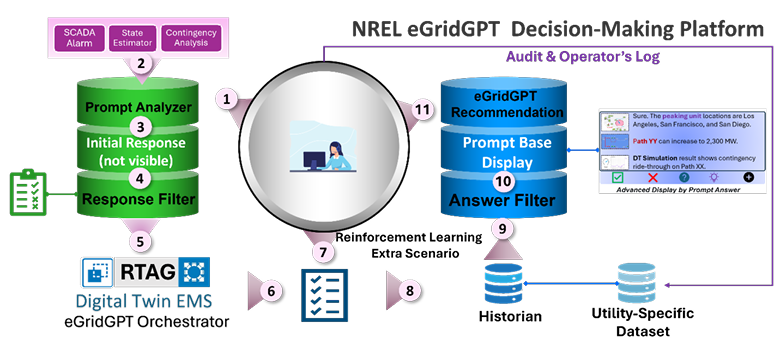
The system works through a structured workflow. When an operator poses a query or prompt, eGridGPT first analyses real time grid data, including measurements from SCADA, state estimations, and contingency analyses. It then processes the operator’s question in the context of this data to generate potential recommendations. These suggestions are tested through simulations before being refined and presented to the operator.
One of the most important aspects of eGridGPT is its use of digital twins—virtual replicas of physical systems that allow AI to simulate grid conditions and validate its recommendations in real time. This approach ensures that the recommendations provided by AI are not only based on historical data or theoretical models but are also grounded in the current, real world state of the grid.
Figure 1: eGridGPT architecture, an AI-based decision support system for grid control rooms
Source: NREL
Ensuring trustworthiness
For AI to be integrated into critical infrastructure like power grids, it must be trustworthy. NREL has designed eGridGPT with trustworthiness as a core principle. The system is structured to ensure that it is valid, reliable, safe, secure, and transparent.
- Reliability and validation: eGridGPT undergoes rigorous validation through its three-step training process, which includes benchmarking against NERC system operator exams. AI’s recommendations are also validated through digital twin simulations to ensure they align with real world physics.
- Safety and security: The system complies with NERC’s Critical Infrastructure Protection (CIP) standards and uses open-source models that run locally, ensuring that sensitive grid data is never exposed to external networks. Additional cybersecurity measures are implemented to prevent vulnerabilities.
- Human-in-the-loop framework: While eGridGPT can offer recommendations, human operators remain in control. This ensures that critical decisions are always vetted by experienced professionals who can judge the appropriateness of AI-generated solutions. The system’s recommendations are transparent, allowing operators to trace the reasoning behind each suggestion.
- Explainability: As an AI tool, eGridGPT is designed to offer explainable outputs, making it easy for grid operators to understand the rationale behind each decision. This is crucial in ensuring that operators trust the system and feel confident acting on its recommendations.
Attesting eGridGPT by digital twin
A major challenge with GenAI is its accuracy, particularly in complex scenarios that can lead to ‘hallucinations’, where inaccurate recommendations arise due to a lack of verifiable data. In the power industry, data for training eGridGPT is often limited, requiring a combination of curated public and private datasets and synthetic data from physics-based digital twin simulations. Digital twins can enhance the credibility of eGridGPT’s responses by validating them against real simulations.
Physics-informed eGridGPT
Operators must document and justify their decisions, as required by NERC CIP standards, which necessitates transparency and accountability. GenAI predictions for power systems must align with the laws of physics. Implementing physics-informed eGridGPT through accurate simulations can yield more efficient, explainable, and reliable solutions.
Explainable eGridGPT
As GenAI systems become more complex, user understanding decreases, which can hinder trust. To be effective, these systems must provide physically grounded and interpretable decisions. eGridGPT’s interactive display can adapt to real time data, enhancing operators’ decision-making by offering clear, explainable recommendations based on the situation’s urgency and alarm severity.
Challenges and limitations of eGridGPT
- Fundamental advances in GenAI: Current GenAI models for language and image generation rely on vast internet datasets, which are insufficient for trustworthy applications in power system operations. To build trust in eGridGPT, advancements in AI and alternative training paradigms are necessary. This includes enabling eGridGPT to make factual predictions and reducing uncertainty across various spatial and temporal scales. Additionally, AI should provide explanations for its suggestions, akin to an engineer’s reasoning process.
- Cybersecurity: Implementing eGridGPT in power systems may introduce cybersecurity vulnerabilities that must be addressed. Compliance with robust cybersecurity policies, including NERC’s CIP standards and the National Institute of Standards and Technology (NIST) Cybersecurity Framework (CSF), is essential to mitigate threats and maintain grid integrity.
- Ethical AI: While GenAI presents opportunities to solve real world issues, it also poses risks. Careful validation of the models and datasets for eGridGPT is necessary to identify biases. The system will operate within a human-in-the-loop framework ensuring ethical and safe AI-driven processes.
- Low-budget on-premises solutions for small utilities: Developing the base eGridGPT model will be costly due to high computational requirements. To alleviate this burden, initial training can be conducted using high-performance computers, like NREL’s Kestrel system. This approach allows for significant time and cost savings, as the base model can then be fine-tuned for specific utilities, ensuring local ownership and compliance with NERC CIP standards.
Conclusion
As the energy landscape continues to evolve, eGridGPT represents a critical step forward in empowering grid operators with cutting-edge tools to manage the complexities of a renewable-powered future. By combining the power of AI with the experience and expertise of human operators, eGridGPT offers a new level of decision-making support that will be essential for ensuring grid reliability, efficiency, and safety. The future of power grid operations is here, and it’s intelligent, trustworthy, and transformative.